
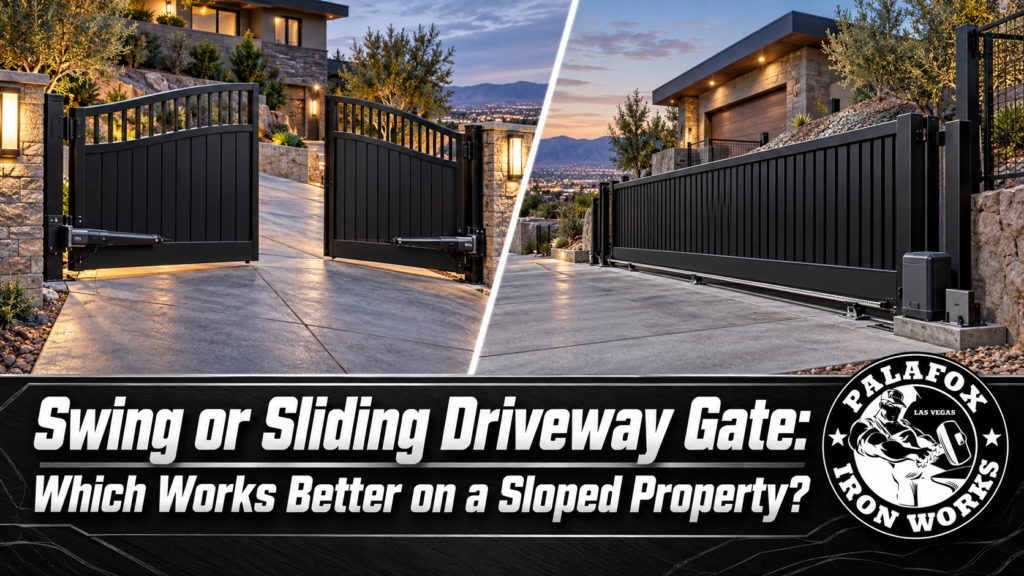
A sliding gate can be a useful option when rising ground prevents a swing gate from opening, but it still needs a suitable travel path and room beside the entrance. A swing gate can work where its full arc clears the ground and surrounding obstacles. Comparing swing vs sliding driveway gates requires checking the direction of the slope, not simply calling the property sloped.
Neither design is automatically better. The entrance layout, vehicle waiting area, drainage, and automation requirements all influence the choice. Begin with a measured site plan so the proposed movement can be evaluated before the gate is fabricated.
Identify Which Direction the Driveway Slopes
A driveway can rise into the property, slope sideways across the entrance, or combine both conditions. Each affects the gate differently.
An inward-opening swing gate can encounter rising paving along its arc. A sliding gate avoids that same arc, but a sideways grade can complicate its track or supporting arrangement.
Measure the proposed gate line and the area where the gate will move. Include changes in elevation beyond the closed position.
Also check whether the slope varies. A driveway that appears gentle near the entrance may rise more sharply where the far end of a swing leaf travels.
Ask the installer to show the movement against the measured elevations. A flat drawing without grade information cannot establish ground clearance.
When a Swing Driveway Gate Can Work
A swing gate needs unobstructed space in front of or behind the entrance, depending on its approved opening direction. Its lower edge must clear the paving throughout the movement.
Consider the ground beneath the far end of the leaf, where the movement covers the largest area. Check walls, landscaping, parked vehicles, and nearby structures as well.
Palafox Creative Iron Works’ custom driveway and security gates provide a starting point for comparing designs. Review the opening arc and support locations alongside the appearance.
Single and Dual Swing Gates
A dual gate uses shorter leaves than a single gate covering the same opening. That changes the swept area, but does not eliminate the need to check the slope under each leaf.
Also decide how the leaves meet and where vehicles wait while they open. The gate should not require an approaching vehicle to occupy its movement area.
Be Careful With Special Rising Arrangements
Some projects use purpose-designed hardware to accommodate grade changes. These arrangements need evaluation as complete systems.
A gate that moves uphill can behave differently when disconnected from an operator. The designer must address support, controlled movement, and compatibility with the selected equipment.
Do not assume that special hinges make a standard operator suitable. Follow the operator manufacturer’s limitations for the actual configuration.
When a Sliding Gate Is Worth Considering
A sliding gate moves across the entrance rather than swinging through the driveway. That can suit a site where the driveway rises behind the gate line.
It also requires side space for the gate to withdraw. The needed area depends on the opening, panel length, supports, and selected sliding arrangement.
Check the full storage position along the fence or wall. A tree, corner, neighboring boundary, or utility cabinet may prevent the gate from opening completely.
The usable driveway width must be evaluated with the gate fully open. A panel that fits on the site but remains partly within the entrance may not provide the required vehicle access.
Track and Cantilever Arrangements
A tracked gate rolls along a prepared track. Its alignment, support, and drainage need coordination with the site.
A cantilever gate uses a support arrangement that avoids a ground track across the opening. It still needs suitable foundations and additional space for its supporting portion.
Neither system should be assumed to follow any ground slope without redesign. Ask how the gate will remain supported and move as required through the entire travel path.
Compare Vehicle Access and Everyday Circulation
Measure the vehicles that regularly use the entrance and consider their approach angle. Turning clearance can matter as much as the nominal opening width.
Plan where a vehicle waits before entering and where it stops after passing through. Check that the waiting position does not block the gate’s movement or interfere with public access.
For a swinging design, allow for both the leaf and any projecting operator components. For a sliding design, keep the side travel and storage area clear.
Discuss pedestrian access separately. An automated vehicle gate should not be treated as the normal walking route; provide an appropriate separate arrangement outside its movement area.
Address Drainage and Maintenance Access
Locate channels, low spots, and areas where runoff crosses the entrance. The installation should not create an unintended dam or redirect water into an unsuitable location.
A ground track can collect debris and needs an accessible cleaning path. Its placement should work with the driveway drainage rather than competing with it.
Swing hinges, sliding supports, stops, and operators also need inspection and maintenance access. Avoid enclosing them behind landscaping that makes service difficult.
Plan Automation Around the Gate Design
An operator must suit the gate’s movement, weight, dimensions, and installation conditions. A motor should not be expected to overcome binding, poor support, or an unsuitable geometry.
The design also needs appropriate entrapment protection and guarding for the hazards created by the moving gate. Vehicle detection is not a substitute for evaluating those hazards.
Review power, control locations, and the approved manual-release procedure. Confirm how the gate behaves during an outage and how users receive operating instructions.
Palafox’s automatic gate and installation services can support that discussion. Compare the gate and its controls as one project rather than adding an opener after the mechanical design is settled.
Conclusion
Compare swing vs sliding driveway gates by mapping the slope and the complete movement area. A swing design needs clear ground and space throughout its arc; a sliding design needs a suitable travel route and room beside the opening. Then evaluate vehicle access, drainage, support, and automation together. Palafox Creative Iron Works can discuss the available gate options against those site measurements. A coordinated plan gives you a clearer basis for choosing the design that will operate practically on your property.
FAQ's
No. It may avoid an inward swing conflict, but side space, travel alignment, foundations, and vehicle access still need review.
Possibly, subject to the site and applicable requirements. Check boundaries, pedestrian routes, vehicle waiting space, and the full opening arc.
Yes. Its supporting arrangement affects the overall panel and storage space. Use the dimensions of the proposed system.

 ICONIER Digital Agency